
This article needs additional citations for verification. Please help improve this article by adding citations to reliable sources . Unsourced material may be challenged
and removed.
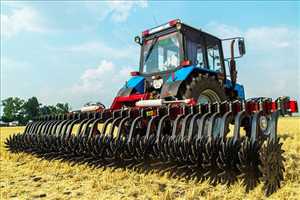
Agriculture , a harrow (often called a set of harrows in a plurale tantum sense) is an implement for breaking up and smoothing out the surface of the soil . In this way it is
distinct in its effect from the plough , which is used for deeper tillage. Harrowing is often carried out on fields to follow the rough finish left by plowing operations. The purpose of this harrowing is generally to break up clods (lumps of soil) and to provide a finer finish, a good tilth or soil structure that is suitable for seedbed use. Coarser harrowing may also be used to remove weeds and to cover seed after sowing. Harrows differ from cultivators in that they disturb the whole surface of the soil, such as to prepare a seedbed, instead of disturbing only narrow trails that skirt crop rows (to kill weeds).
There are four general types of harrows: disc harrows, tine harrows (including spring-tooth harrows, drag harrows, and spike harrows), chain harrows, and chain-disk harrows.
Harrows were originally drawn by draft animals, such as horses, mules, or oxen, or in some times and places by manual labourers . In modern practice they are almost always tractor -mounted implements, either trailed after the tractor by a drawbar or mounted on the three-point hitch . A modern development of the traditional harrow is the rotary power harrow, often just called a power harrow. [1]
TYPES
In cooler climates the most common types are the disc harrow , the chain harrow , the tine harrow or spike harrow and the spring tine harrow . Chain harrows are often used for
lighter work such as levelling the tilth or covering seed,while disc harrows are typically used for heavy work, such as following ploughing to break up the sod . In addition, there are various types of power harrow , in which the cultivators are power-driven from the tractor rather than depending on its forward motion.
Tine harrows are used to refine seed-bed condition before planting, to remove small weeds in growing crops and to loosen the inter-row soils to allow for water to soak into the subsoil. The fourth is a chain disk harrow. Disk attached to chains are pulled at an angle over the ground. These harrows move rapidly across the surface. The chain and disk rotate to stay clean while breaking up the top surface to about 1 inch (3 cm) deep. A smooth seedbed is prepared for planting with one pass.
 purity's blog