Featured

Fabrican Limited Technology

Fabrican’s patented spray-on fabric technology starts as a liquid suspension which is sprayed by a spray gun or an aerosol can.  The fabric is formed by the cross-linking of fibers which adhere to each other and to the surface sprayed to create an instant non-woven fabric. The versatility of a sprayable fabric coating that seamlessly conforms to any shape removes technical and economic barriers to offering consumers customized products. Fabrican’s spray technology enable producers to readily vary products’ physical properties (shape, size, texture, colour—even scent) to suit each customer’s specification, without the need for re-tooling or stocking different grades of material. Fabrican uses different types of fibers, from natural to synthetic, including keratin fibers such as wool and mohair, cotton, nylon, cellulose, and carbon nanofibres.

Fabrican is the product of interdisciplinary research, linking the subjects of engineering, material science and design. The commercial development of products and manufacturing processes is underway, and the technology is licensed to global brands in several commercial sectors.

Fabrican is at the forefront of innovations in material science, developing smart fabrics incorporating nano-technology, “second skin” for the medical and cosmetic industries, and sprayable conductive fabrics to interface with wearable technology.  Spray-on fabrics liberate product and apparel designers from the constraints imposed by the need for cutting to size, stitching, and fitting of traditional materials.
CROP SPRAYER

SPRAYER

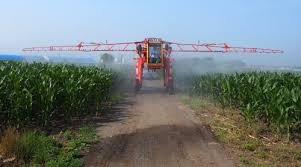
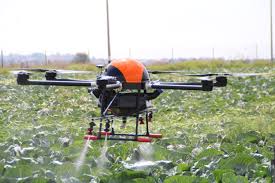
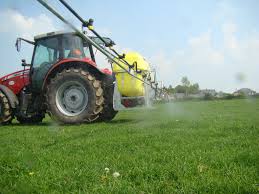
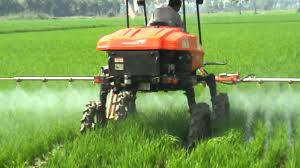
sprayer is a device used to spray a liquid, where sprayers are commonly used for projection of water, weed killers, crop performance materials, pest maintenance chemicals, as well as manufacturing and production line ingredients. In agriculture, a sprayer is a piece of equipment that is used to apply herbicidespesticides, and fertilizers on agricultural crops. Sprayers range in size from man-portable units (typically backpacks with spray guns) to trailed sprayers that are connected to a tractor, to self-propelled units similar to tractors, with boom mounts of 4-30 feet up to 60–151 feet in length depending on engineering design for tractor and land size

CROP SPRAYER

Sprayers are fully integrated, mechanical systems, meaning they are composed of various parts and components that work together to achieve the desired effect, in this case: the projection of the spray fluid. This can be as simple as a hand sprayer attached to a bottle that is pumped and primed by a spring-lever, tube, and vacuum-pressure; or as complex as a 150 foot reach boom sprayer with a list of system components that work together to deliver the spray fluid.

For more complex sprayers, such as agricultural sprayers, common system components include: the spray nozzle, sometimes with a spray gun, fluid tank, sprayer pump, pressure regulators, valves and gaskets, and fluid plumbing.[2] The sprayer pump can be just as important as the sprayer type itself as there are many sprayer pump design types with various construction materials, inlet/outlet sizes, and performance specifications. Common sprayer pump types include diaphragm, centrifugal, and roller pumps

sprayer

Harrowing machine

This article needs additional citations for verification. Please help improve this article by adding citations to reliable sources . Unsourced material may be challenged
and removed.

Harrowing machine

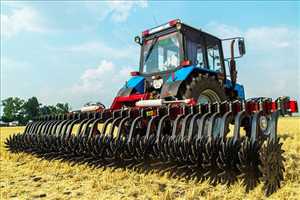
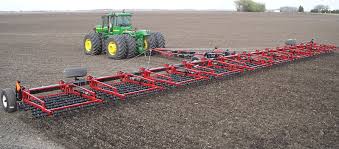
Agriculture , a harrow (often called a set of harrows in a plurale tantum sense) is an implement for breaking up and smoothing out the surface of the soil . In this way it is
distinct in its effect from the plough , which is used for deeper tillage. Harrowing is often carried out on fields to follow the rough finish left by plowing operations. The purpose of this harrowing is generally to break up clods (lumps of soil) and to provide a finer finish, a good tilth or soil structure that is suitable for seedbed use. Coarser harrowing may also be used to remove weeds and to cover seed after sowing. Harrows differ from cultivators in that they disturb the whole surface of the soil, such as to prepare a seedbed, instead of disturbing only narrow trails that skirt crop rows (to kill weeds).
There are four general types of harrows: disc harrows, tine harrows (including spring-tooth harrows, drag harrows, and spike harrows), chain harrows, and chain-disk harrows.
Harrows were originally drawn by draft animals, such as horses, mules, or oxen, or in some times and places by manual labourers . In modern practice they are almost always tractor -mounted implements, either trailed after the tractor by a drawbar or mounted on the three-point hitch . A modern development of the traditional harrow is the rotary power harrow, often just called a power harrow. [1]

TYPES
In cooler climates the most common types are the disc harrow , the chain harrow , the tine harrow or spike harrow and the spring tine harrow . Chain harrows are often used for
lighter work such as levelling the tilth or covering seed,while disc harrows are typically used for heavy work, such as following ploughing to break up the sod . In addition, there are various types of power harrow , in which the cultivators are power-driven from the tractor rather than depending on its forward motion.
Tine harrows are used to refine seed-bed condition before planting, to remove small weeds in growing crops and to loosen the inter-row soils to allow for water to soak into the subsoil. The fourth is a chain disk harrow. Disk attached to chains are pulled at an angle over the ground. These harrows move rapidly across the surface. The chain and disk rotate to stay clean while breaking up the top surface to about 1 inch (3 cm) deep. A smooth seedbed is prepared for planting with one pass.

HARROWING

COTTON PICKER

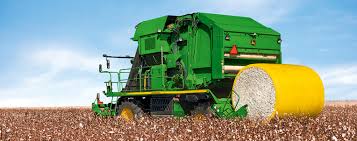
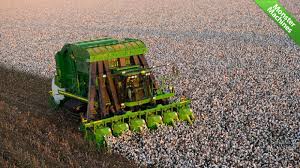
The cotton picker is a machine that automates cottonharvesting in a way that reduces harvest time and maximizes efficiency.

COTTONPICKER

You’re probably wearing something cotton-y right now. Cotton is fairly annoying to harvest. Mechanization was a quantum leap for the cotton industry, moving it away from archaic methods used since the days of slavery. This machine is the next step forward.

Up until World War II, cotton harvesting in the South remained nearly identical to the way it was prior to the Emancipation, with large labor forces picking cotton by hand. It wasn’t until the Great Migration had sufficiently reduced the available labor force did hand-picking become economically inefficient. When it did reach that level, mechanized processes took over. The innovations aboard the John Deere 7760 could potentially be just as big as the original move to machines.

The 7760 is a Spindle-type cotton picker. As it moves down a set of cotton rows, the plants are herded towards a set of spindle bars on either side of the six picking heads. These spindles are designed to pick only the open cotton from the rest of the plant without damaging the foliage or unopened bolls. The cotton fiber is then conveyed up a set of ducts via air jets into the accumulator. There, four feedrolls convey the cotton stored in the accumulator to the two rear feedrolls that flatten the cotton into a mat and place it on a belt that feeds the cotton into the round module builder. This module builder rolls the mat of cotton into an 8-foot wide, 5000-pound stack, wraps it in a protective cover and releases it onto the transportation arms. This allows the 7760 to drop completed bundles at the end of rows without having to stop to offload its cargo. Essentially it’s a method of continuous cotton harvesting, a massive step forward for the industry.

COTTON PICKER

MANURE SPREADER

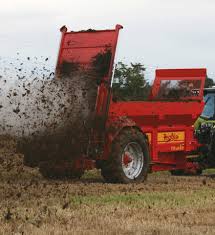
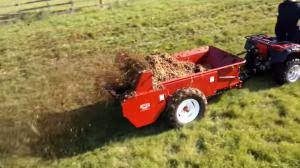
manure spreader or muck spreader or honey wagon is an agricultural machine used to distribute manure over a field as a fertilizer. A typical (modern) manure spreader consists of a trailer towed behind a tractor with a rotating mechanism driven by the tractor’s power take off

Manure spreaders began as ground-driven units which could be pulled by a horse or team of horses. Many of these ground-driven spreaders are still produced today, mostly in the form of small units that can be pulled behind a larger garden tractor or an all terrain vehicle (ATV). In recent years hydraulic and PTO driven units have been developed to offer variable application rates. Several models are also designed with removable rotating mechanisms (beaters), attachable side extensions, and tailgates for hauling chopped forages, cereal grains, and other crops. A typical (modern) manure spreader consists of a trailer towed behind a tractor with a rotating mechanism driven by the tractor’s power take off (PTO).

How to use a manure spreader.

manure spreader

If you have livestock, then you have manure. It’s just a fact of life. It’s also a fact that you have to clean it up and do something with it. So if you have livestock and manure, you need a manure spreader.

This video is about how to use a Frontier MS1112 Manure Spreader (US CA). We’ve matched it with a John Deere 5100E Utility Tractor (US CA) complete with an operator cab. That’s a pretty nice feature to have on your tractor if you’re going to be spreading manure. Because you can’t always be moving into the wind.

This manure spreader has a heaped capacity of 125 bushels. When fully loaded with dry manure, it will weigh about 4500 pounds (2041 kg). With a load that heavy, it’s important to make sure you have enough stopping power, just in case you need it. That’s another reason we’re using the heavier 5100E Utility Tractor.

The MS1112 is a pull-type implement, so hooking and unhooking is quite simple using a locking pin and clip. And don’t forget the safety chain.

Before each use, it’s a good idea to check the tension of the drive chains in each side of this PTO-driven spreader. Their tensions should be matched as closely as possible, and can be tightened individually with a simple and lock nut mechanism.

The MS1112 manure spreader uses a 2-speed gearbox that controls the speed of the paddle beaters. A simple rope-pull system allows the operator to shift from low to high speed from inside the cab. The coverage you apply to your pasture will depend on your ground speed and the manure spreader gearbox speed setting.

When you’re done, you can also shift to a Clean Out setting, which stops the paddle beaters from turning while the apron continues to push any material out the back of the manure spreader cleaning.

spreader


Unmanned aerial vehicle

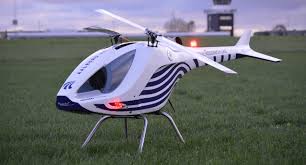
An unmanned aerial vehicle, commonly known as a drone, is an aircraft without a human pilot onboard. UAVs are a component of an unmanned aircraft system; which include a UAV, a ground-based controller, and a system of communications between the two

UNMANNED AIRCRAFT

What Is the Best Drone on the Market?

Even if you have no good reason to justify buying one, you have to admit that drones are cool. Some are glorified tech toys, but most models we highlight here are fit for use in imaging and cinematic applications small and large. If you think you can use a flying camera in your next project, there’s some good news—the tech has come a long way in a very short time. There are models on the market now that put earlier copters to shame in terms of video quality and stabilization.

And now the bad news. You get what you pay for, and if you want an aerial video platform that can capture stunning footage, you need to be ready to spend some cash. Because drones are such pricey propositions, it pays to do your research before buying one. We’ve tested many of the ready-to-fly models on the market to determine what’s important to look for, and the best models available.

AGRICULTURE DRONE
Design a site like this with WordPress.com
Get started