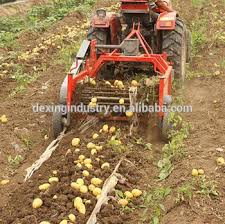
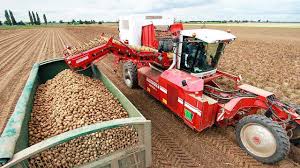
Potato harvesters are machines that harvest potatoes. They work by lifting the potatoes from the bed using a share. Soil and crop are transferred onto a series of webs where the loose soil is sieved out. The potatoes are moved towards the back of the harvester on to a separation unit and then (on manned machines) to a picking table where people pick out the stones, clods, and haulms by hand. The potatoes then go on to a side elevator and into a trailer or a potato box
POTATO HARVEST
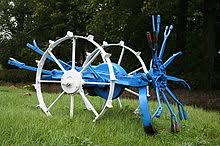
A potato spinner is connected to a tractor through the three-point linkage. Older machines were drawn by horse and were driven by a ground drive. It works by a flat piece of metal which runs horizontal to the ground lifting the potatoes up and a large wheel with spokes on it called a reel pushing the clay and potatoes out to the side. The potatoes are then gathered by hand, placed into containers and transported from the field for further packaging.
POTATO SPINNER
The potato spinner is becoming obsolete because modern potato harvesting equipment eliminates manual gathering of potatoes and leaves fewer potatoes in the soil.
Haulm topper
A tractor with a front-mounted haulm topper and a trailed potato harvester
A haulm topper is an agricultural machine that cuts potato stems (haulms) before potatoes are harvested. It is like a flail mower but has the profile of the potato drills. Modern potato farmers often mount a haulm topper on the front of the tractor and have a trailed potato harvester towed behind the tractor. Toppers can also be rear-mounted. It is a very efficient machine.
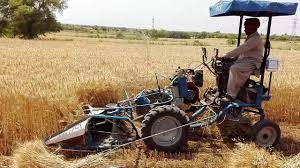
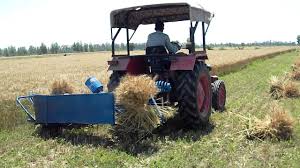
A reaper is a farm implement or person that reaps (cuts and often also gathers) crops at harvest when they are ripe. Usually the crop involved is a cereal grass. The first documented reaping machines were Gallic reaper that was used in modern-day France during Roman times. The Gallic reaper involved a comb which collected the heads, with an operator knocking the grain into a box for later threshing.[1]
Most modern mechanical reapers cut the grass; most also gather it, either by windrowing it or picking it up. Modern machines that not only cut and gather the grass but also thresh its seeds (the grain), winnow the grain, and deliver it to a truck or wagon it are called combine harvesters or simply combines; they are the engineering descendants of earlier reapers.
Hay is harvested somewhat differently from grain; in modern haymaking, the machine that cuts the grass is called a hay mower or, if integrated with a conditioner, a mower-conditioner. As a manual task, cutting of both grain and hay may be called reaping, involving scythes, sickles, and cradles, followed by differing downstream steps. Traditionally all such cutting could be called reaping, although a distinction between reaping of grain grasses and mowing of hay grasses has long existed; it was only after a decade of attempts at combined grain reaper/hay mower machines (1830s to 1840s) that designers of mechanical implements began resigning them to separate classes.[
Mechanical reapers substantially changed agriculture from their appearance in the 1830s until the 1860s through 1880s, when they evolved into related machines, often called by different names (self-raking reaper, harvester, reaper-binder, grain binder, binder), that collected and bound the sheaves of grain with wire or twine.[ Today reapers and grain binders have been largely replaced by combines in commercial farming, but some smaller farms still use them.
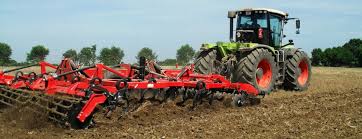
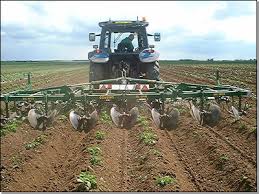
A cultivator is any of several types of farm implement used for secondary tillage. One sense of the name refers to frames with teeth (also called shanks) that pierce the soil as they are dragged through it linearly. Another sense refers to machines that use rotary motion of disks or teeth to accomplish a similar result. The rotary tiller is a principal example.
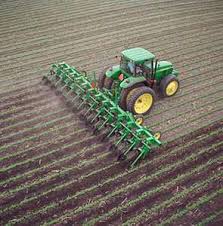
Cultivators stir and pulverize the soil, either before planting (to aerate the soil and prepare a smooth, loose seedbed) or after the crop has begun growing (to kill weeds—controlled disturbance of the topsoil close to the crop plants kills the surrounding weeds by uprooting them, burying their leaves to disrupt their photosynthesis, or a combination of both). Unlike a harrow, which disturbs the entire surface of the soil, cultivators are designed to disturb the soil in careful patterns, sparing the crop plants but disrupting the weeds.
Cultivators of the toothed type are often similar in form to chisel plows, but their goals are different. Cultivator teeth work near the surface, usually for weed control, whereas chisel plow shanks work deep beneath the surface, breaking up hardpan. Consequently, cultivating also takes much less power per shank than does chisel plowing.
Small toothed cultivators pushed or pulled by a single person are used as garden tools for small-scale gardening, such as for the household’s own use or for small market gardens. Similarly sized rotary tillers combine the functions of harrow and cultivator into one multipurpose machine.
Cultivators are usually either self-propelled or drawn as an attachment behind either a two-wheel tractor or four-wheel tractor. For two-wheel tractors they are usually rigidly fixed and powered via couplings to the tractors’ transmission. For four-wheel tractors they are usually attached by means of a three-point hitch and driven by a power take-off (PTO). Drawbar hookup is also still commonly used worldwide. Draft-animal power is sometimes still used today, being somewhat common in developing nations although rare in more industrialized economies.
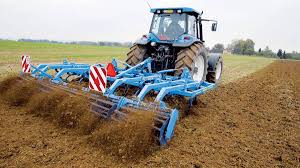
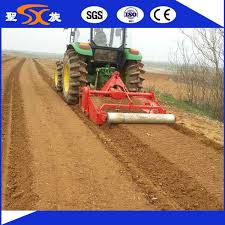
Ridger is a primary soil tillage machine is mounted and trailed from tractor’s hydraulic lifting unit and universal three point linkage system. Therefore transportation to the field can be easily done.
Furrow opener is placed over the chassis. It has an opportunity to enter between rows as demanded width due to its adjustable moldboards.
The usage aim of the machine is to open furrows between rows and ridging for row-planted seeds such as; corn, sunflower, cotton, etc.
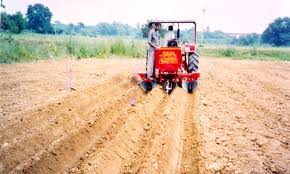
Traditionally farmers in semi-arid areas in Eastern Sudan harvest water for agriculture by manual construction of terraces that consume high levels of physical effort and time. During 2007 a Practical Action Food Security Project in Kassala introduced a ridge maker for terrace erection as an appropriate technology that is cost-effective and suitable for the local environment whilst still achieving the technical standard required. The ridge maker is superior to other methods of terrace construction in terms of both quality and cost.
The ridge maker is a tool usually pulled by a tractor to form ridges that form the terrace. It is very fast at constructing terraces; it can complete 100 meters of terrace in one minute. This means it takes just four minutes to construct a crescent shaped terrace spanning five feddans, see pictures.
A planter is a farm implement, usually towed behind a tractor, that sows (plants) seeds in rows throughout a field.[1] It is connected to the tractor with a drawbar or a three-point hitch. Planters lay the seeds down in precise manner along rows. Planters vary greatly in size, from 1 row to 54, with the biggest in the world being the 48-row John Deere DB120. Such larger and newer planters comprise multiple modulescalled row units.[1] The row units are spaced evenly along the planter[1] at intervals that vary widely by crop and locale. The most common row spacing in the United States today is 30 inches.[1]
Various machines meter out seeds for sowing in rows. The ones that handle larger seeds tend to be called planters, whereas the ones that handle smaller seeds tend to be called seed drills, grain drills, and seeders (including precision seeders). They all share a set of similar concepts in the ways that they work, but there is established usage in which the machines for sowing some crops including maize (corn), beans, and peas are mostly called planters, whereas those that sow cereals are drills.
On smaller and older planters, a marker extends out to the side half the width of the planter and creates a line in the field where the tractor should be centered for the next pass. The marker is usually a single disc harrow disc on a rod on each side of the planter. On larger and more modern planters, GPS navigation and auto-steer systems for the tractor are often used, eliminating the need for the marker. Some precision farming equipment such as Case IH AFS uses GPS/RKS and computer-controlled planter to sow seeds to precise position accurate within 2 cm. In an irregularly shaped field, the precision farming equipment will automatically hold the seed release over area already sewn when the tractor has to run overlapping pattern to avoid obstacles such as trees.
Older planters commonly have a seed bin for each row and a fertilizer bin for two or more rows. In each seed bin plates are installed with a certain number of teeth and tooth spacing according to the type of seed to be sown and the rate at which the seeds are to be sown. The tooth size (actually the size of the space between the teeth) is just big enough to allow one seed in at a time but not big enough for two. Modern planters often have a large bin for seeds that are distributed to each row known as central commodity systems.
A class of planters that dig down farther than others are called listers. They are not used much anymore, as their use belonged to a set of high-till methods that low-till and no-till methods have largely replaced. Corn listers were common on the Great Plains in the 1920s through 1950s.
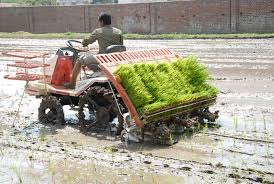
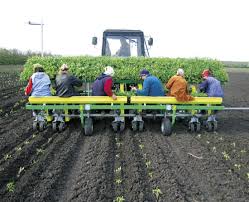
RICE TRANSPLANTER
Drive systems
There are different types of planters available with the main difference being mechanically driven vs. hydraulic/electrical driven. In a mechanical drive system the unit works by a small suspended tire being driven by another which is in contact with the ground (driven) tire. As the operator lowers the planter the two tires make contact and the planter is engaged. When the driven wheel begins to turn it then turns a series of gears that determine the population of the seed produced. The gears can be changed by the operator in order to change the planting population. A hydraulic driven system came about to correct the shortfalls of the ground driven system. Hydraulic driven systems allow the operator to change population on the go, as well as allowing the computer controller to follow a prepared prescription for an individual field. The system also allowed for plant populations to be infinite in that mechanical gears systems are limited to set number of population settings and gears available from manufactures. In 2014 John Deere introduced the ExactEmerge row unit which introduced high-speed planting.[2] Precision Planting followed suit and released the vDrive system. These system were unique, not that they were electrical, but that they allowed an operator to double their speed when planting. Other manufacturers had already developed an electrical planter, but lacked these additional improvements. Traditionally, an operator would plant at about 4.5-5.5 mph for optimal performance. However, with the advent of these systems electrical motors match the speed of the tractor and “dead-drop” the seed in the trench using either a belt or brush-belt which cause the forward momentum of the planter to be offset by the rearward momentum of the seed. Older systems would instead drop the seed through a tube after the meter rather than place it in the seed trench directly.



 purity's blog